
Bathroom counter organization for small spaces usually comes down to one reality: you don’t have too much stuff, you have too little “assigned space.” When everything lives on the counter by default, even a clean bathroom looks messy, and your morning routine slows down.
The good news is you don’t need a remodel, and you don’t need to become a minimalist overnight. Most small counters can feel bigger just by setting clear zones, choosing containers that fit the footprint, and moving the “rarely used” items off the counter.
What trips people up is doing one big tidy, then watching it fall apart two days later. This guide focuses on setups that stay organized because they match how you actually use the sink area.
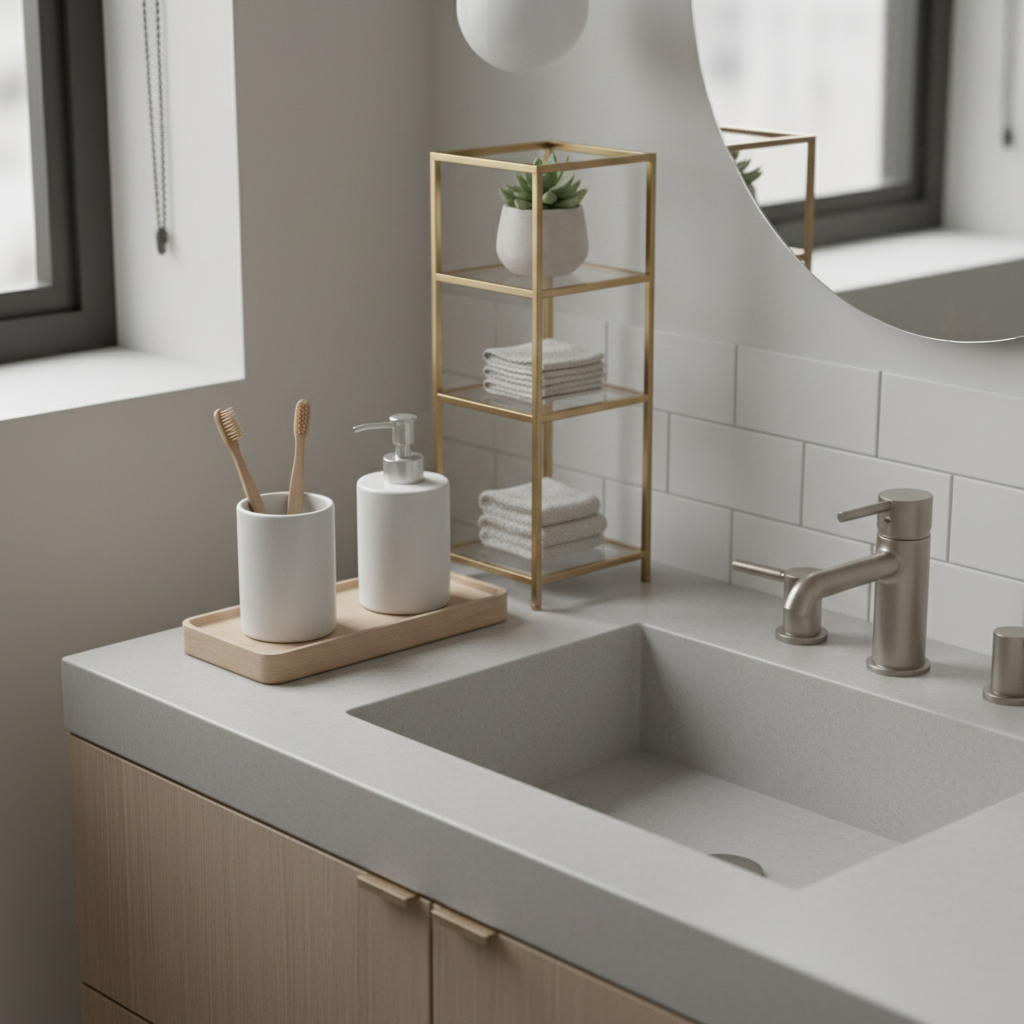
Why small bathroom counters get cluttered so fast
Small counters don’t forgive “temporary” items. A hair tool left out, one extra serum, a pile of cotton pads, and suddenly you’re working around clutter instead of using the space.
- Too many categories in one spot, skincare, haircare, dental, makeup, meds, contacts, all competing for the same 18 inches.
- No container boundaries, without trays or cups, items spread out and multiply visually.
- Daily vs. weekly use mixed together, the backup razor heads sit next to the toothpaste because “it fits.”
- Cleaning is annoying, if you have to move 20 items to wipe the counter, you’ll wipe less often, then clutter feels even worse.
One more thing that’s easy to miss: lighting and mirror size can exaggerate mess. A busy counter reflected in a big mirror looks twice as chaotic, even when the quantity is modest.
A quick self-check: what kind of counter clutter do you have?
Before buying organizers, figure out your clutter type. It changes the fix, and it saves money.
- “Too many daily essentials”: more than 8–12 items you truly use every morning or night.
- “No home for backups”: extra toothpaste, refills, travel sizes, and samples living on the counter.
- “Shared sink chaos”: multiple people mixing items with no personal zones.
- “Wet-zone creep”: products migrate close to the faucet and get splashed, then you keep moving them around.
If you’re not sure, do a 60-second test: clear the counter, then put back only what you used in the last 24 hours. Whatever you still “need” to return after that is your true daily set.
Set up the counter like a workstation (zones that actually work)
The most reliable approach for bathroom counter organization for small spaces is to treat the counter like a tiny workstation with strict zones. If something doesn’t belong to a zone, it doesn’t live on the counter.
Zone 1: The wet zone (closest to faucet)
Keep this sparse, because water and splatter make everything grimy faster.
- Hand soap or foaming soap dispenser
- One small hand lotion (optional)
- A slim microfiber cloth tucked nearby if your counter constantly shows water spots
Zone 2: The daily kit (one tray, one decision)
Put the daily items you don’t want to think about into a single tray. The tray is the “boundary,” and it also makes cleaning easier because you lift one thing instead of 12.
- AM: moisturizer + SPF, or PM: cleanser + moisturizer
- Deodorant or fragrance if you truly use it at the sink
- Any item you reach for every day without exception
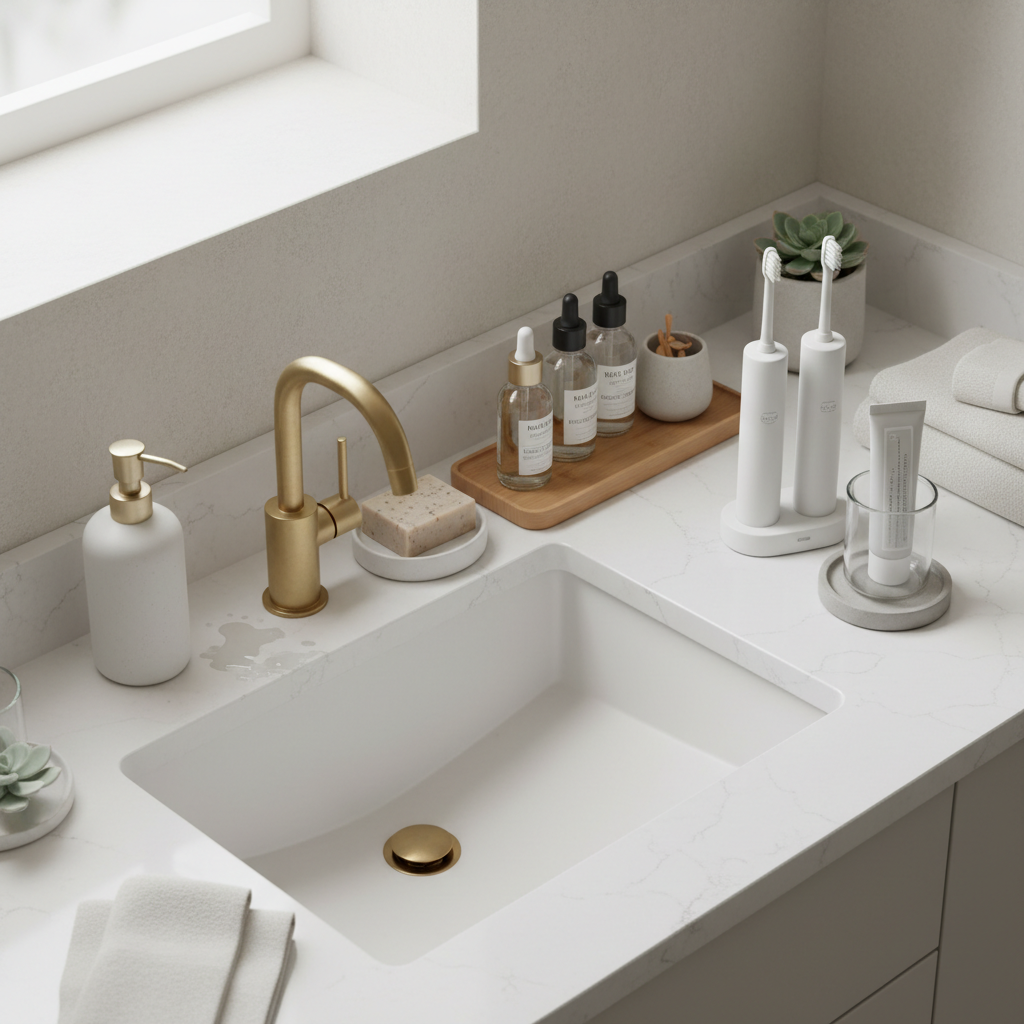
Zone 3: Dental corner (vertical beats spread-out)
A toothbrush holder and a small cup are usually enough. If you use an electric toothbrush, consider a holder that keeps the base footprint tight.
According to the American Dental Association (ADA), toothbrushes should be stored upright and allowed to air-dry, which is another reason to avoid stuffing them into closed containers.
Choose organizers that fit small counters (and don’t waste space)
Most organizer fails come from buying pieces that look good online but don’t match the counter’s depth, faucet placement, or drawer situation. In small bathrooms, “slim” and “stacked” usually win.
| Organizer | Best for | Watch-outs |
|---|---|---|
| Small tray (8–12 in) | Daily kit boundary, easy wipe-down | Too large becomes a clutter magnet |
| Tiered riser | Using vertical space behind faucet | Blocks mirror outlets or looks crowded if oversized |
| Lazy Susan (small) | Skincare rotations, shared products | Can bump into faucet on narrow counters |
| Magnetic strip or wall hooks | Tools like tweezers, nail clippers | Adhesive quality varies, test on an inconspicuous spot |
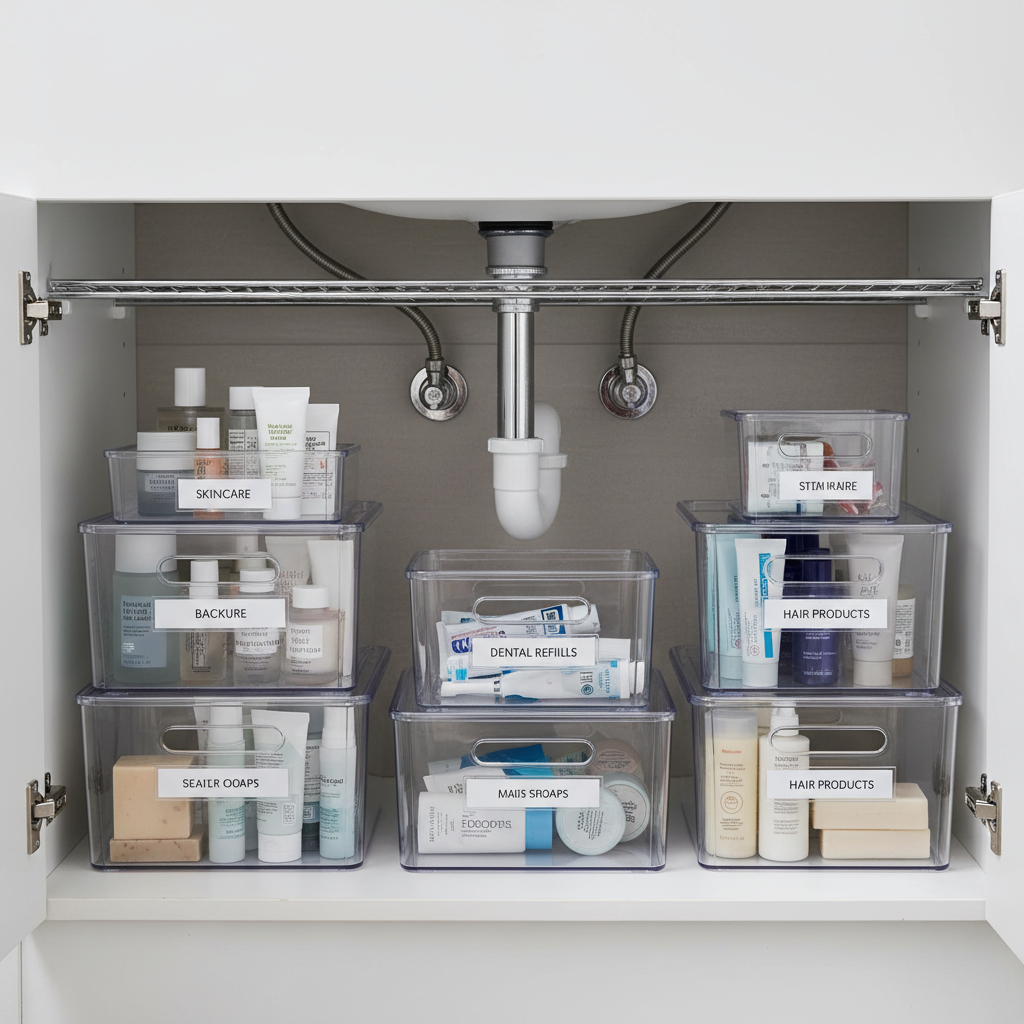
| Stackable clear bins under sink | Backups and refills off the counter | Measure pipes and slopes before buying |
Material matters more than people think. In bathrooms, easy-clean plastic, stainless steel, sealed bamboo, or resin tends to handle moisture better than untreated wood or fabric bins that soak up humidity.
Step-by-step: a 30-minute reset that lasts
If you want a setup that sticks, don’t start by “organizing.” Start by editing what earns a spot on the counter.
1) Clear and sort into three piles
- Daily: used nearly every day
- Weekly/occasionally: hair masks, special treatments, makeup you don’t use daily
- Backups: refills, extras, samples, travel sizes
2) Put daily items back with a hard cap
A practical cap for small spaces is often one tray plus one dental holder, and maybe one “tool cup.” If you can’t fit your daily items inside those boundaries, you have too many on-counter items for the size of your bathroom, and something has to move to a drawer or cabinet.
3) Assign an off-counter home for weekly items
Weekly products still need to be easy, or they’ll creep back. A shallow drawer insert, a small bin under the sink, or a cabinet shelf near eye level usually works.
4) Contain backups like a store shelf
Backups should be grouped by type, hair, dental, skin, and labeled if multiple people share the space. This is the moment where bathroom counter organization for small spaces actually becomes sustainable, because you stop “storing” inventory where you get ready.
Real-world setups for common small-space scenarios
Not every bathroom has drawers. Not every sink is single-user. Here are setups that match typical constraints.
If you have zero drawers
- Use a tall, narrow caddy for daily items, instead of spreading them across the counter.
- Add a wall-mounted shelf above the toilet for weekly items, keeping the counter calm.
- Store backups in a lidded bin under the sink to reduce visual noise.
If two people share one small counter
- Give each person one tray or one bin, same size, same rules.
- Keep shared items in the middle: soap, toothpaste, a common hand lotion.
- Agree on a “no stray items” rule, if it’s not in your tray, it goes back.
If your counter is narrow and everything tips
- Switch to low-profile containers and shorter bottles when possible.
- Use adhesive grip pads under trays so they don’t slide when you reach.
- Consider a riser only if it doesn’t crowd the faucet area.
Common mistakes that make organization fail
Most “Pinterest-perfect” counters fail because they ignore how bathrooms get used on busy mornings.
- Keeping too many open containers: they look tidy at first, then collect dust, hair, and splashes.
- Buying organizers before measuring: depth and faucet clearance matter more than style.
- Letting samples live on the counter: they multiply fast and rarely get used.
- Using tall jars for small tools: you can’t see what’s inside, so you dump everything out.
- No reset routine: even 60 seconds nightly makes the difference.
Key point: if you can’t wipe the counter in under a minute, the system is too complicated for daily life.
When to rethink the space (safety, moisture, and “this is bigger than clutter”)
If your counter stays damp, products can get sticky, labels peel, and organizers degrade faster. Improving ventilation, using a dehumidifier, or running the exhaust fan longer can help, and if you’re unsure about moisture issues or mold risk, it’s smart to consult a qualified professional.
Also, if you’re storing medications at the sink, double-check whether heat and humidity in your bathroom are appropriate for what you keep. According to the U.S. Food and Drug Administration (FDA), many medicines should be stored in a cool, dry place, and bathrooms often do not meet that standard.
Conclusion: keep the counter for getting ready, not storing inventory
Small bathrooms feel calmer when the counter has a clear job: support your routine, not hold every product you own. A tray-based daily kit, a simple dental corner, and a real home for backups usually get you 80% of the way there without overthinking.
Pick one action today: do the 24-hour put-back test, or set up one tray and commit to keeping everything else off the counter for a week. That’s where the habit forms, and the clutter stops coming back.