
How to organize jewelry in small spaces starts with a simple truth: you don’t need more containers, you need a system that matches how you actually get ready.
If your jewelry ends up in one “miscellaneous” bowl, you’re not messy, you’re just working with friction, tangled chains, missing earring backs, and pieces you forget you own. Small spaces amplify that problem because every surface turns into storage by accident.
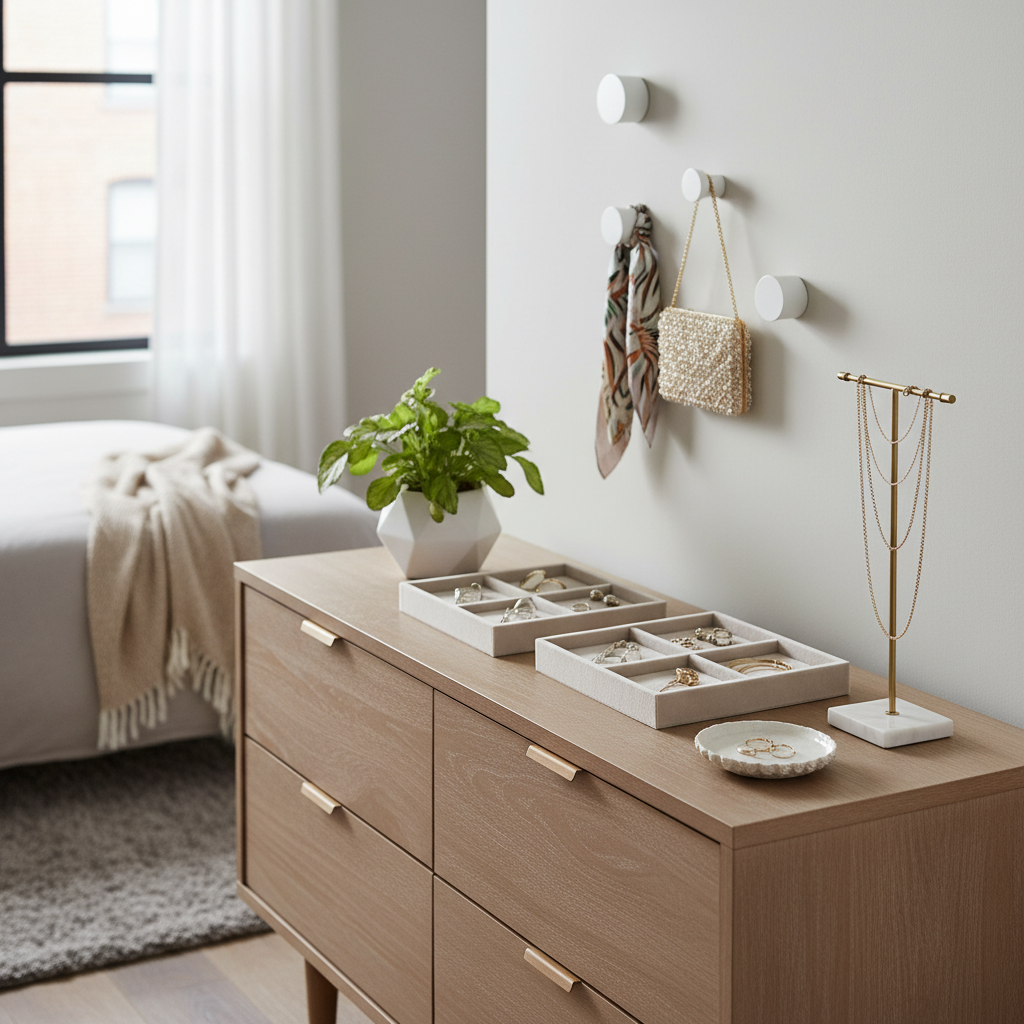
This guide focuses on practical choices: what to keep within reach, what to store out of sight, and how to prevent tangles without buying a whole new organizer set. You’ll also get a quick self-check, a storage table, and a routine that stays easy after week two.
Why small spaces make jewelry harder to manage
Most jewelry “clutter” comes from a few predictable pain points, and small rooms don’t give you much buffer.
- Micro-items multiply fast: studs, backs, rings, and charms slide into drawers and disappear.
- Chains behave badly: even one necklace in a pile invites knots, add three and it’s a project.
- Storage gets too deep: stacking cases inside a drawer makes the bottom layer basically dead space.
- You need speed: if it takes 5 minutes to find earrings, you’ll stop putting things away.
According to the National Association of Professional Organizers (NAPO), organizing works best when you group items by how you use them, not by what you wish you used. That mindset matters a lot in tight quarters.
Quick self-check: what kind of jewelry mess do you have?
Before you reorganize, figure out what’s actually causing the daily annoyance. Pick the closest match and you’ll know which solution section to lean on.
- Tangle problem: necklaces and delicate chains knot every time you open the drawer.
- Visibility problem: pieces are “stored,” but you forget they exist until you buy duplicates.
- Category problem: everything lives together, so you’re sorting through mixed items each morning.
- Volume problem: you own more than your current space can hold without stacking.
- Damage problem: pearls, plated pieces, or costume jewelry scratch or tarnish in a pile.
Key takeaway: if you only fix containers, but not the friction, you’ll be back to the same bowl in a month.
Choose a “home base” that fits your routine
In small spaces, the best spot is usually where you already make decisions: by the mirror, near the closet, or next to the sink if you remove jewelry at night. The goal is one consistent landing zone.
Common home bases that work in apartments and shared rooms:
- Top drawer near your getting-ready area: best for everyday pieces you rotate.
- Wall space beside a mirror: best when surface space is limited.
- Inside a closet door: helpful if you need things out of sight.
- Nightstand tray: good if you remove rings/earrings before bed, but keep it contained.
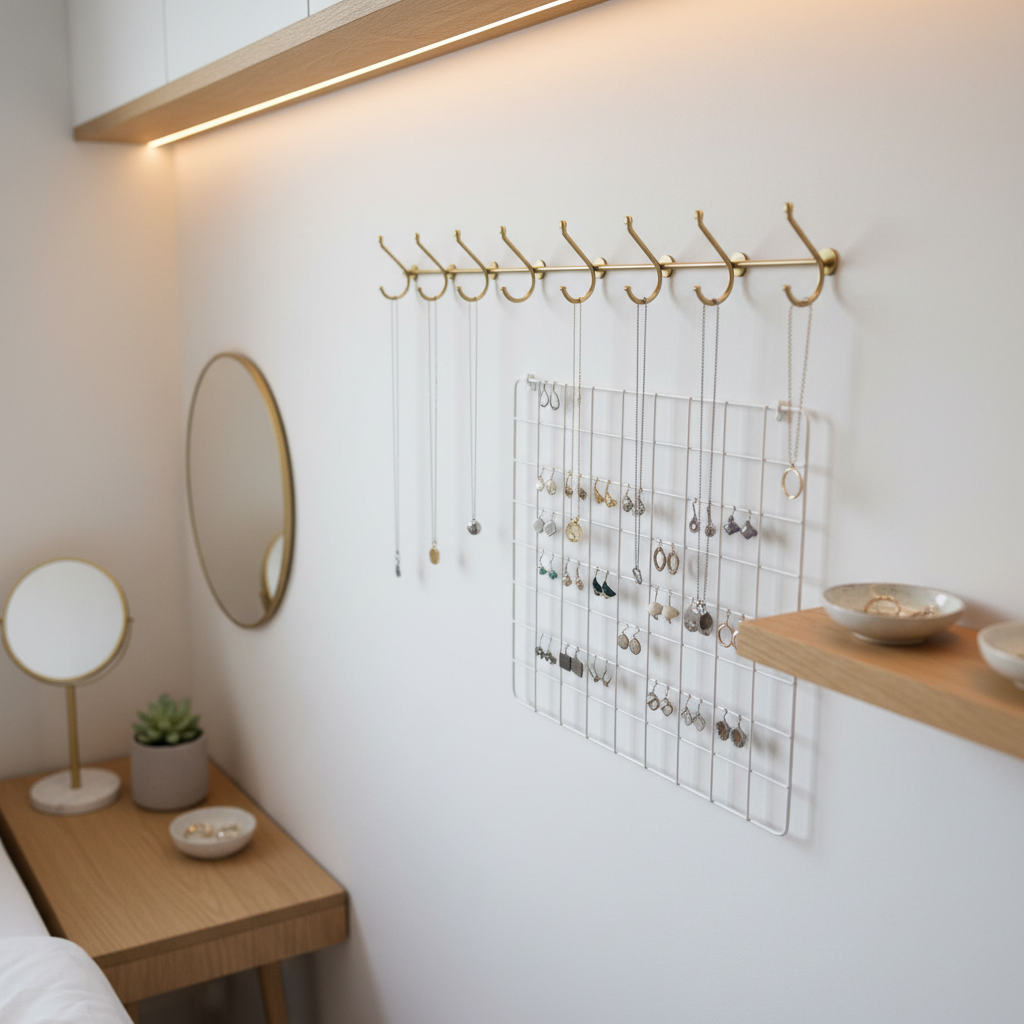
Try a two-zone approach: daily zone for what you wear weekly, and a storage zone for everything else. This is often the simplest way to organize jewelry in small spaces without needing more square footage.
Storage methods that actually work (and when to use them)
There’s no single “perfect” organizer, but some tools solve specific problems better than others. Use this table as a quick match-up.
| Jewelry type | Best small-space storage | Why it works | Watch-outs |
|---|---|---|---|
| Necklaces | Wall hooks, necklace bar, individual pouches | Keeps chains separated to prevent knots | Keep away from humid bathrooms if possible |
| Stud earrings | Compartment tray, pill-style mini box, earring cards | Stops backs from disappearing | Label if you own many similar pairs |
| Hoops/dangles | Earring grid, hanging organizer | Fast visibility, no digging | Spacing matters to avoid tangling |
| Rings | Ring bar, slotted insert, small dish for daily use | Prevents scratching and makes selection quick | Don’t overfill slots |
| Bracelets/watches | Stackable tray, watch roll, drawer divider | Controls bulk, keeps pairs together | Heavy pieces can dent soft trays over time |
| Fine/fragile pieces | Soft-lined box, individual bags | Reduces abrasion and tangles | Out of sight can mean out of mind |
Small-space rule that saves sanity: avoid deep “drop-in” bins for mixed jewelry. If you can’t see the bottom layer, you won’t use it.
A 30-minute setup: sort, assign, and reset
If you want results fast, do a short reset instead of a weekend-long overhaul. This is the approach I see people stick with.
Step 1: Pull everything out and do a rough sort
- Make five piles: necklaces, earrings, rings, bracelets/watches, “special/fragile.”
- Set aside broken items and single earrings in a small bag, don’t let them rejoin the chaos.
Step 2: Decide what earns a spot in the daily zone
- Choose what you wear weekly, plus one “nice” option for quick upgrades.
- Limit daily-zone necklaces to what you can hang without overlap.
Step 3: Assign containers based on friction, not aesthetics
- Tangles? Prioritize separation: hooks, bars, pouches.
- Lost backs? Prioritize compartments with a lid.
- Forgotten pieces? Prioritize visibility: trays, grids, shallow drawers.
Step 4: Add one tiny “return point”
A ring dish or mini tray near where you remove jewelry reduces random placement. Keep it small on purpose, if it fills up, it forces a reset.
Space-saving ideas for specific tight layouts
Different small spaces fail in different ways. Pick what matches your room and skip the rest.
Studio or shared bedroom
- Use vertical space: a hook rail or pegboard keeps jewelry off surfaces.
- Go inside-door: closet-door hanging organizers work when you need visual calm.
- Keep valuables discreet: a small locking box might make sense for some households.
Small bathroom
- Be careful with humidity: moisture can speed tarnish for some metals, so storing everything in the bathroom may not be ideal.
- If you must store there: use a closed container with compartments and keep it away from the shower area.
No drawer space at all
- Stackable trays on one shelf: shallow layers beat one deep box.
- Wall-mounted mini shelf + hooks: acts like a micro vanity.
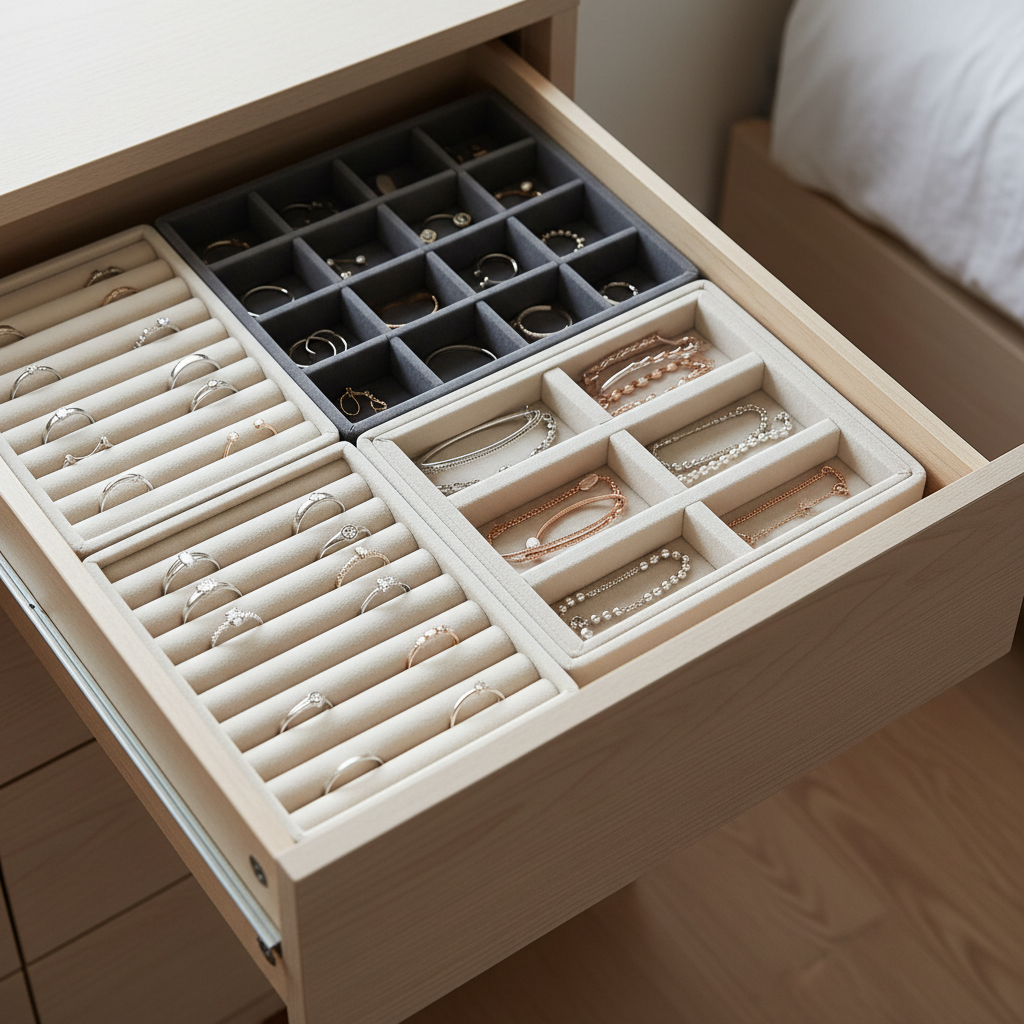
If you’re reorganizing because you’re moving, this is also the best moment to make the daily zone smaller. It’s the easiest way to organize jewelry in small spaces without turning it into a craft project.
Common mistakes (and what to do instead)
- Mistake: buying a big organizer first. Do instead: sort and measure the space you’ll actually use, then choose storage that fits.
- Mistake: mixing chains and earrings in one pouch. Do instead: separate by type, and keep chains hanging or in individual sleeves.
- Mistake: “out of sight” becomes “never worn.” Do instead: rotate seasonal or special pieces into the daily zone once a month.
- Mistake: keeping broken items in the main system. Do instead: create a repair bag with a decision date.
Also, don’t ignore lighting. It sounds unrelated, but if you can’t see what you own, you’ll keep defaulting to the same few pieces.
When it’s worth getting help or upgrading storage
If you’re handling valuable jewelry, sentimental items, or you’ve had issues with loss, a more secure approach may be worth it. A jeweler can advise on safe storage for specific materials, and a professional organizer can help design a small-space setup that fits your routine without adding visual clutter.
If you notice skin irritation from certain pieces, it’s smart to ask a healthcare professional, since reactions can vary and aren’t always obvious at first.
Conclusion: keep it simple, keep it visible, keep it easy to reset
Most people don’t fail at organizing, they build a system that asks too much every day. Give your everyday favorites a clear home base, separate anything that tangles, and keep storage shallow enough that you can see what you own.
If you want one action to start today, pick a daily zone and set up a tiny return point, that alone cuts down the wandering jewelry problem.
Key points to remember:
- Design around your getting-ready routine, not a picture-perfect organizer.
- Prevent tangles by storing chains separately, hanging works well in tight spaces.
- Use shallow, visible storage so pieces don’t disappear into layers.
If you’d like, share what you’re working with (drawer dimensions, closet door space, and how many necklaces/earrings you own), and I can suggest a small-space layout that fits without overbuying.