
How to organize makeup in small bathroom spaces comes down to one thing: stop letting your counter act like a storage unit, then give every item a predictable “home” that fits your real routine.
If your bathroom is small, it’s usually not just about having “too much makeup”, it’s that storage sits in the wrong places, daily essentials mix with backups, and you end up digging through piles when you’re half-awake. That’s when products expire, brushes get dusty, and you buy duplicates because you can’t find what you already own.
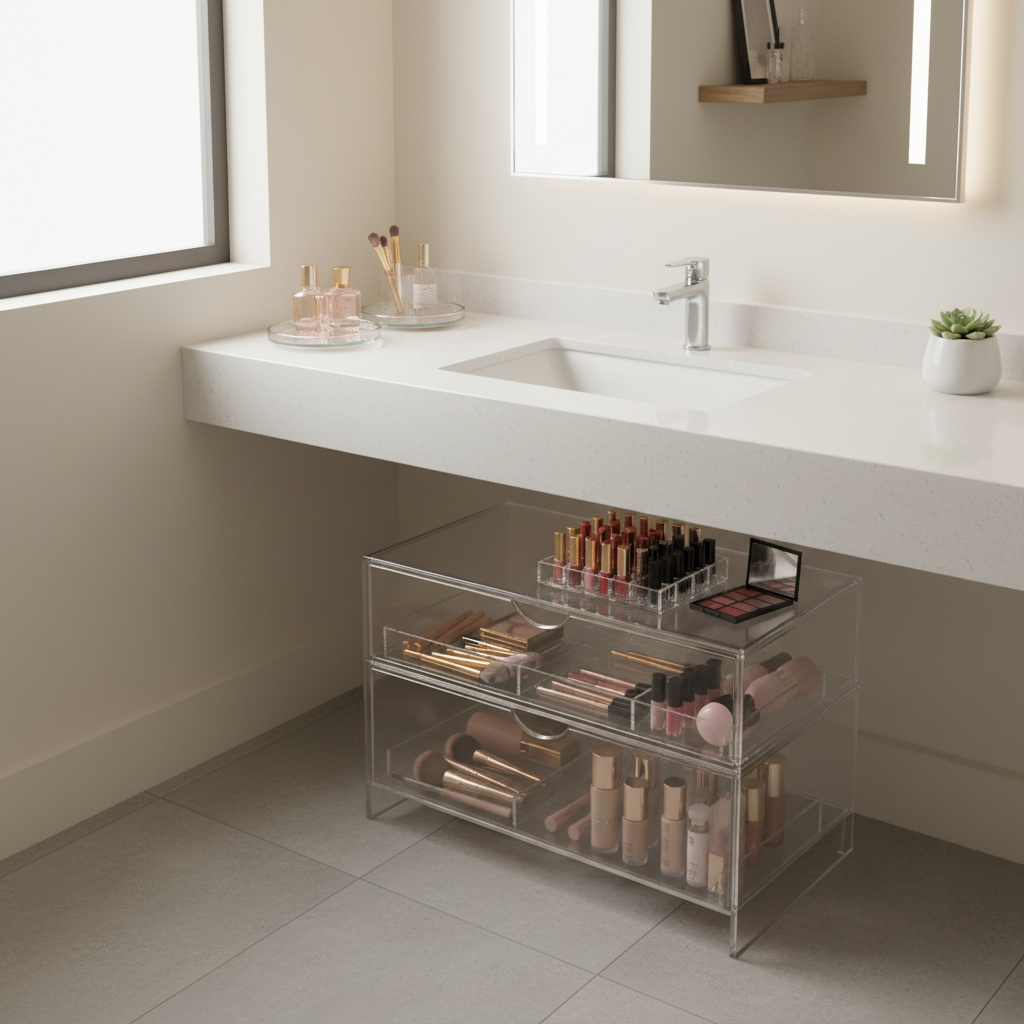
This guide keeps it practical: you’ll set up zones, pick storage that works in tight spaces, and build a 5-minute reset so your setup stays organized without “reorganizing” every weekend.
Start with a quick reality check: what’s actually causing the mess?
Most small-bathroom makeup chaos comes from a few predictable patterns, not from you “being disorganized.”
- Counter as default storage: if items live on the counter, they multiply and spread, fast.
- No separation between daily makeup and occasional makeup: everything competes for the same prime spot.
- Too many tiny categories: five different cups of pencils looks “sorted,” yet it still eats all your surface area.
- Backups mixed with active products: you keep opening new items because the half-used ones vanish.
- Humidity + dust: bathrooms can be tough on powders, brushes, and packaging, which pushes people to leave lids off or items out “to dry.”
According to the American Cleaning Institute (ACI), keeping frequently used areas clear and cleaning regularly helps reduce grime buildup and makes maintenance easier, which matters more when a space is tight.
Declutter in one pass (without turning it into a full-day project)
Before buying organizers, do one focused edit. The goal is not minimalism, it’s removing friction.
The 4-pile method (15–25 minutes)
- Daily: what you use most mornings.
- Weekly/occasion: date-night, full-glam, special lip colors.
- Tools: brushes, sponges, lash curler, sharpeners.
- Backups/overstock: unopened extras, refills, travel minis.
Be a little strict with “Weekly/occasion.” In a small bathroom, that category can’t be 60% of your stash, or you’ll be right back where you started.
Safety and hygiene note (worth taking seriously)
Makeup expiration varies by product type and storage conditions. If something smells off, changes texture, or irritates skin, it’s usually safer to replace it. For sensitive skin or eye issues, consider asking a dermatologist or eye-care professional rather than guessing.
Create 3 zones that match how you get ready
When people ask how to organize makeup in small bathroom setups, this is the part that changes everything: fewer zones, but clearer rules.
- Zone 1: “Grab & go” daily kit (highest-access spot)
- Zone 2: “Get-ready” extras (secondary drawer/bin)
- Zone 3: Backups + rarely used (out of the bathroom if possible)
Why keep backups out of the bathroom? Humidity can shorten the life of some products, and overstock tends to snowball when it’s visible every day.
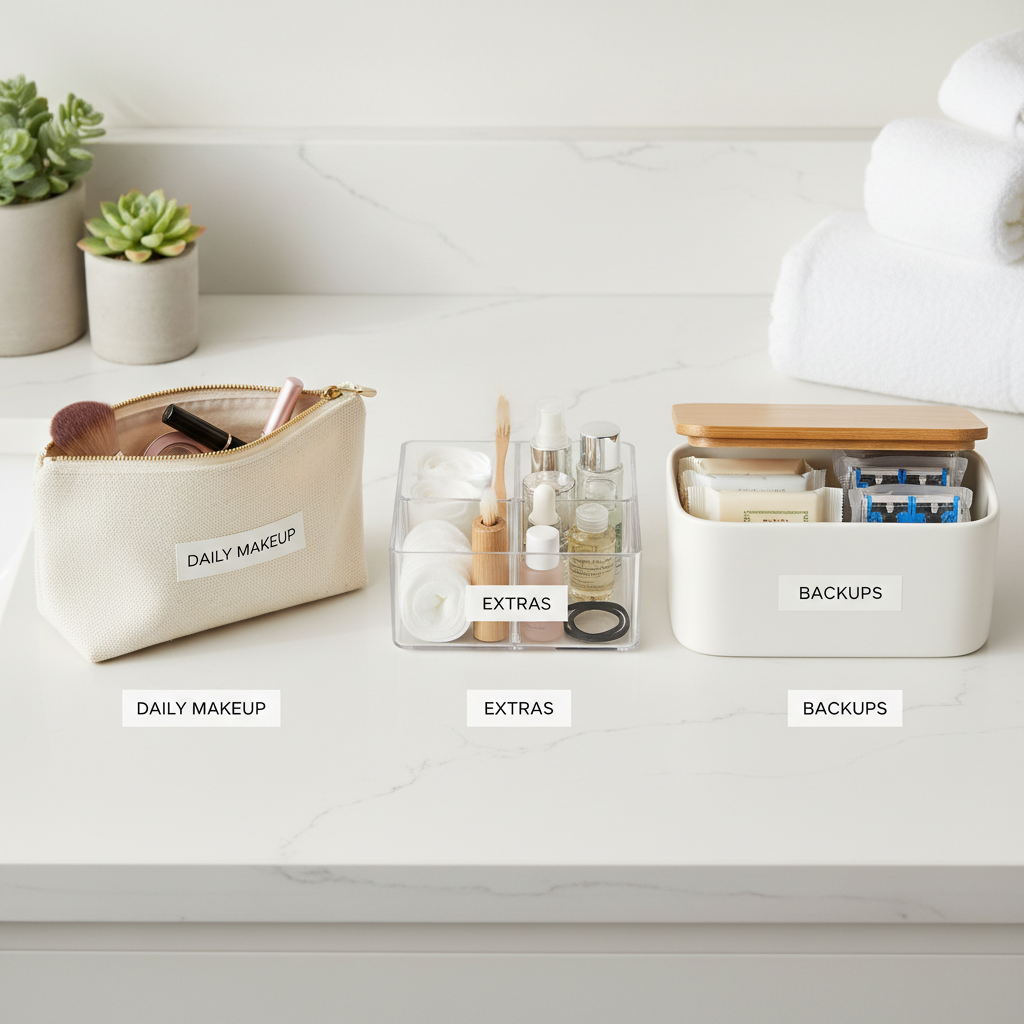
Key point: your daily kit should be small enough that you can lift it with one hand, use it, then put it away. If it’s heavy or sprawling, it won’t get put back.
Choose storage that works in tight spaces (and what to skip)
Storage in a small bathroom is less about “more containers” and more about the right shapes: vertical, lidded, and easy to wipe.
What tends to work well
- Stackable drawers (acrylic or plastic): great for maximizing vertical space inside cabinets.
- Shallow drawer inserts: keeps lip products and compacts from becoming a pile.
- Lidded bin for tools: protects brushes from bathroom dust and aerosol hair products.
- Over-the-door or wall-mounted cabinet: if you’re truly out of vanity space.
- One slim tray on the counter: only for the day’s essentials, not your whole collection.
What often backfires
- Open cups full of products: looks cute for a week, then becomes clutter.
- Deep bins without dividers: everything sinks and you lose items at the bottom.
- Too many micro-organizers: the setup becomes harder to maintain than the mess.
A simple setup plan (by bathroom type)
Different bathrooms fail in different ways, so here are setups that match the space you actually have.
If you have one vanity drawer
- Front third: daily kit items (foundation/concealer, brow, mascara, one lip, powder).
- Middle: brushes in a slim divider, plus sponge in a ventilated case.
- Back: weekly/occasion products, grouped by face/eye/lip.
Keep the counter tray tiny. If it can hold 20 items, it will.
If you have no drawers (pedestal sink or tiny rental bath)
- Daily: small makeup bag stored in a wall cabinet or a shelf.
- Extras: a narrow rolling cart outside the bathroom door, or a shelf in the bedroom.
- Tools: lidded box, stored high to avoid splashes.
In this setup, the bathroom holds “today,” not your full inventory. It’s the easiest way to stay sane.
If you share the bathroom
- Give yourself one clearly defined footprint: one drawer, one bin, one shelf.
- Use labels only where it prevents fights: “daily,” “tools,” “backups.”
Shared spaces collapse when boundaries are vague. Clarity beats perfection.
Quick reference table: match product types to the best spot
Use this as a cheat sheet while you set up your zones.
| Category | Best storage in a small bathroom | Why it works |
|---|---|---|
| Daily face products | Shallow drawer insert or small tray | Fast access, less countertop spread |
| Lip products | Divided organizer (short sections) | Stops “lipstick pile” syndrome |
| Eye products | Single bin with divider (liner/mascara/shadows) | Keeps categories together without tiny clutter |
| Brushes & tools | Lidded container or drawer compartment | Less dust and overspray exposure |
| Backups & travel minis | Separate labeled bin outside bathroom | Prevents overstock taking over prime space |
Make it stay organized: the 5-minute reset (no heroics)
The secret to how to organize makeup in small bathroom spaces is maintenance that feels almost too easy. If the system needs 30 minutes every Sunday, it won’t survive a busy month.
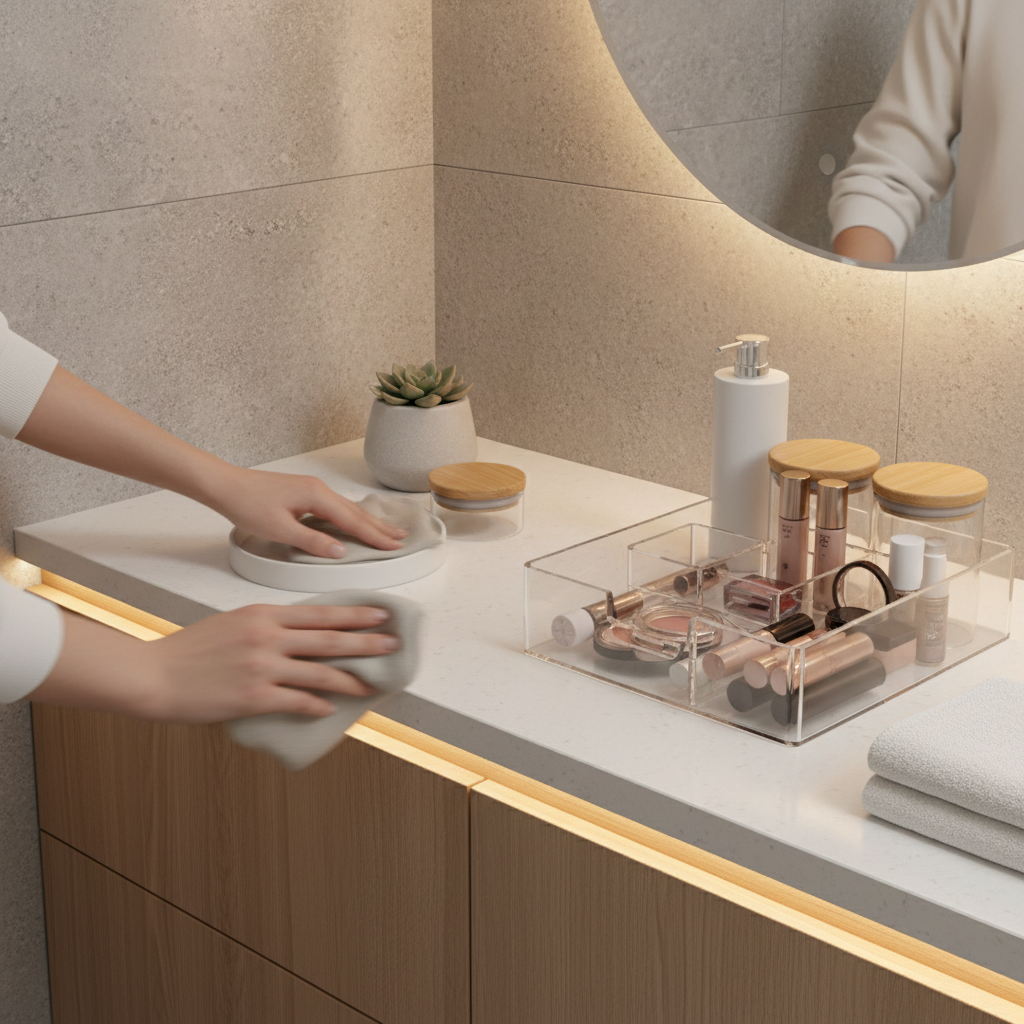
- Put back 5 items: the ones that drift onto the counter.
- Wipe the tray: 20 seconds makes everything look intentional.
- Check one “problem” category: usually lip products, cotton pads, or hair tools.
- Replace one thing you’re out of: so you don’t open backups in a panic.
If you do this 3–4 times a week, your bathroom stops feeling “small,” because you stop seeing clutter first.
Common mistakes that waste space (and how to fix them)
- Mistake: Organizing by brand instead of by use.
Fix: group by your routine steps, not the logo. - Mistake: Keeping every brush at the sink.
Fix: keep 3–5 daily brushes accessible, store the rest away. - Mistake: Using the medicine cabinet for everything.
Fix: reserve it for daily skincare, not bulk makeup and tools. - Mistake: Buying organizers before measuring.
Fix: measure drawer depth, cabinet height, and door clearance first, even rough notes help.
When it’s worth getting extra help (or changing the plan)
If you’re constantly dealing with irritation around the eyes, frequent breakouts, or recurring infections, organizing alone may not solve the underlying issue, and a clinician may give safer guidance on product use and replacement timing. If clutter connects to stress, ADHD, or overwhelm, a professional organizer or therapist can help build routines that match your life rather than an ideal Pinterest version.
Conclusion: a small bathroom can still feel calm
Once you stop storing everything on the counter and commit to a daily kit, how to organize makeup in small bathroom spaces becomes much simpler than it sounds. Start with three zones, choose storage that stacks and closes, then protect the system with a 5-minute reset.
If you only do two things this week, make it these: shrink your daily lineup and move backups out of the bathroom. That alone usually frees more space than any new organizer.
FAQ
How do I organize makeup in a small bathroom with no storage?
Keep only a small daily bag in the bathroom, then store the rest in a bedroom drawer, shelf, or rolling cart outside the door. In tight rentals, “bathroom storage” often has to be minimal by design.
What’s the best way to keep makeup off the counter?
Use one small tray as a boundary, then store everything else in a drawer or lidded bin. If the tray fills up, treat that as your signal to edit the daily kit.
Should I store makeup in the medicine cabinet?
It can work for a few daily items, but medicine cabinets get overcrowded quickly. Many people do better using it for skincare and keeping makeup in a drawer system below.
How can I organize brushes in a humid bathroom?
A lidded container or a drawer compartment helps protect brushes from humidity and hairspray residue. Let brushes dry fully after washing, and if you notice persistent skin irritation, consider asking a dermatologist for guidance.
How do I organize makeup for a shared bathroom?
Claim one defined area, like a single drawer or bin, and keep your daily kit compact. Labels help when they prevent mix-ups, but you don’t need to label every category.
How often should I clean makeup organizers?
A quick wipe weekly keeps residue from building up. If you use powders often, you may want a more thorough clean monthly, especially for drawer inserts and trays that collect dust.
What if I have too many products to fit, even after decluttering?
That usually means your bathroom can’t be the main storage location. Move the “weekly/occasion” group to a separate place and rotate items seasonally, so the bathroom stays functional.
If you’re trying to organize makeup in a small bathroom and you’d rather not guess which organizers fit your vanity, it may help to map your zones first, then buy only the few pieces that support your daily kit and keep backups out of sight.